 HyperFrames
Preview gallery
The job to start with
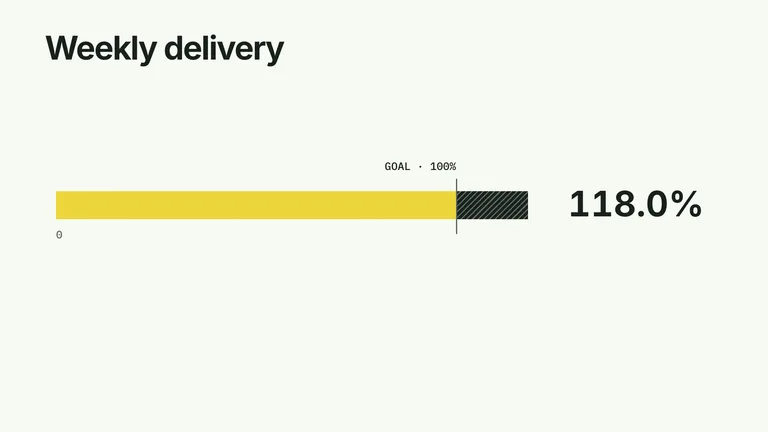
Use CreatorMotion · Ratio Bars to show the ratio between two quantities on a common scale. Start by deciding what your audience needs to understand; use the preview to judge whether this format serves that goal.
Picked most often by
Plan your first result
Use the brief below as a starting point. Replace the placeholders, review a small draft, then expand it.
When to choose it
You have a short message that benefits from a sequence, rather than a single still. Decide what the viewer should understand at the end.
Prepare the material
Prepare approved copy, real interface material or permitted footage, target duration and delivery size. Decide whether audio is needed before selecting a provider.
Prepare these package inputs
labels- Name the compared entities; keep the names short enough for the frame.
values- Use verified numbers and state their common unit and reporting period.
unit- Choose one unit and use it consistently in labels and values.
ratioPrecision- Choose the displayed precision after checking the denominator is nonzero.
A first brief to adapt
Use CreatorMotion · Ratio Bars to show the ratio between two quantities on a common scale. My audience is [audience], and the material I can provide is [sources]. Approve a shot list or one short section first. Match reading time to the content before rendering the complete video. Recalculate the ratio, reject a zero denominator and keep both quantities on a common scale. Flag missing facts before producing the final output.
The review that matters here
Recalculate the ratio, reject a zero denominator and keep both quantities on a common scale.
Know the boundary
The preview demonstrates a direction, not a recording of your product. Replace sample claims and results with your own; audio or image services may cost extra.
What you need before you start
- You bring
- labels: provide your own content or retain the illustrative default. · values: provide your own content or retain the illustrative default. · unit: provide your own content or retain the illustrative default. · ratioPrecision: provide your own content or retain the illustrative default.
- Dependencies
- HyperFrames CLI 0.8.30 or compatible — required · Node.js 22 or newer — required · FFmpeg — required
- Package compatibility record
- v1.0.1 — Claude Code / Claude Desktop / Cowork / Codex / ChatGPT
Run the installed Skill or use its bundled generator. Supply an output folder with --out, optional content JSON with --data, and a local video with --media for presenter effects. An optional --images JSON map replaces only its named slots; relative paths resolve beside that JSON file. Read references/image-policy.md before adapting visual material. The default style is white-yellow; alternatives are Charcoal & Lime (charcoal-lime), Paper & Orange (paper-orange), and Black & White (the compatible midnight-ice ID). Inter, Noto Sans SC and Smiley Sans are bundled locally. Chinese content uses Smiley Sans by default; pass --zh-font noto-sans-sc for the plainer Noto Sans SC. IBM Plex Mono is used for measurements and ordinal labels. Dark canvases have a fine grid.
From package to deliverable
- Use the package to build a video sequence in your own environment. Keep the editable project alongside the rendered result for later revisions.
- Agree on duration, aspect ratio and reading time before the full render. Use your own verified statements and permitted footage.
A useful first milestone
- A workflow to show the ratio between two quantities on a common scale.
Before handing it over
- Recalculate the ratio, reject a zero denominator and keep both quantities on a common scale.
- The preview demonstrates a direction, not a recording of your product. Replace sample claims and results with your own; audio or image services may cost extra.
Content Creation & PublishingCreate Broll AnimationStyle-lockedSeries-consistentEditable OutputMinimalistEditorialTypographic
User reviews
Loading reviews…
FAQ
Recalculate the ratio, reject a zero denominator and keep both quantities on a common scale.
Approve a shot list or one short section first. Match reading time to the content before rendering the complete video.
The preview demonstrates a direction, not a recording of your product. Replace sample claims and results with your own; audio or image services may cost extra.